A person on the important steps
Approval gates before anything is sent, paid or promised. In the first week you approve everything. After that, only what your rules say.
AI automation · Auckland, for businesses everywhere
AI that answers enquiries, drafts quotes, chases invoices and sorts the inbox, with a person on every step that matters. Scroll through a week and watch the chores go.
Automate the chores, keep the craft · we take the reading, typing, chasing and copying. The judgement stays with you
A person on every important step · approval gates, audit trails and a kill switch, so nothing goes out that you wouldn't send
On the tools you already run · Xero, MYOB, Monday.com, HubSpot, Shopify, Gmail and Outlook, Slack, Tradify, and anything with an API
Businesses we work with
























Fifteen automations we build for New Zealand businesses, each with its trigger, its steps, the hours back and where a person stays in charge. Open any card for its steps. Together that's 35+ hours a week, and most businesses start with three.
Pick what starts it, switch the steps on or off, then run it and watch the log fill. The yellow step is a person: the AI drafts and they decide.
Eight emails, the way they really arrive. Press triage: each is read, tagged and ranked, the routine ones get a draft reply in your voice, and the ones that need you go to the top.
Set the sliders to your volumes and switch automations on or off. These are planning figures from businesses we've done this for, and we measure your real number in the first week.
That’s 10.6 working days a month, worth about $89,326 a year of your time.
19.6 hours of the craft a week. 940 hours a year.
Automation is only useful if you can trust it. Every flow we ship comes with these three.
Approval gates before anything is sent, paid or promised. In the first week you approve everything. After that, only what your rules say.
What triggered it, what the AI read, what it wrote, who approved it and when it went. Searchable, exportable, yours.
Hosted in Sydney or Auckland, no customer data used to train anything, Privacy Act in mind from day one. A kill switch on every automation.
On the tools you already run
We start with your week, on a whiteboard, with the people who live it. The first three automations are chosen on hours back, built in a fortnight, and run beside you until you trust them.
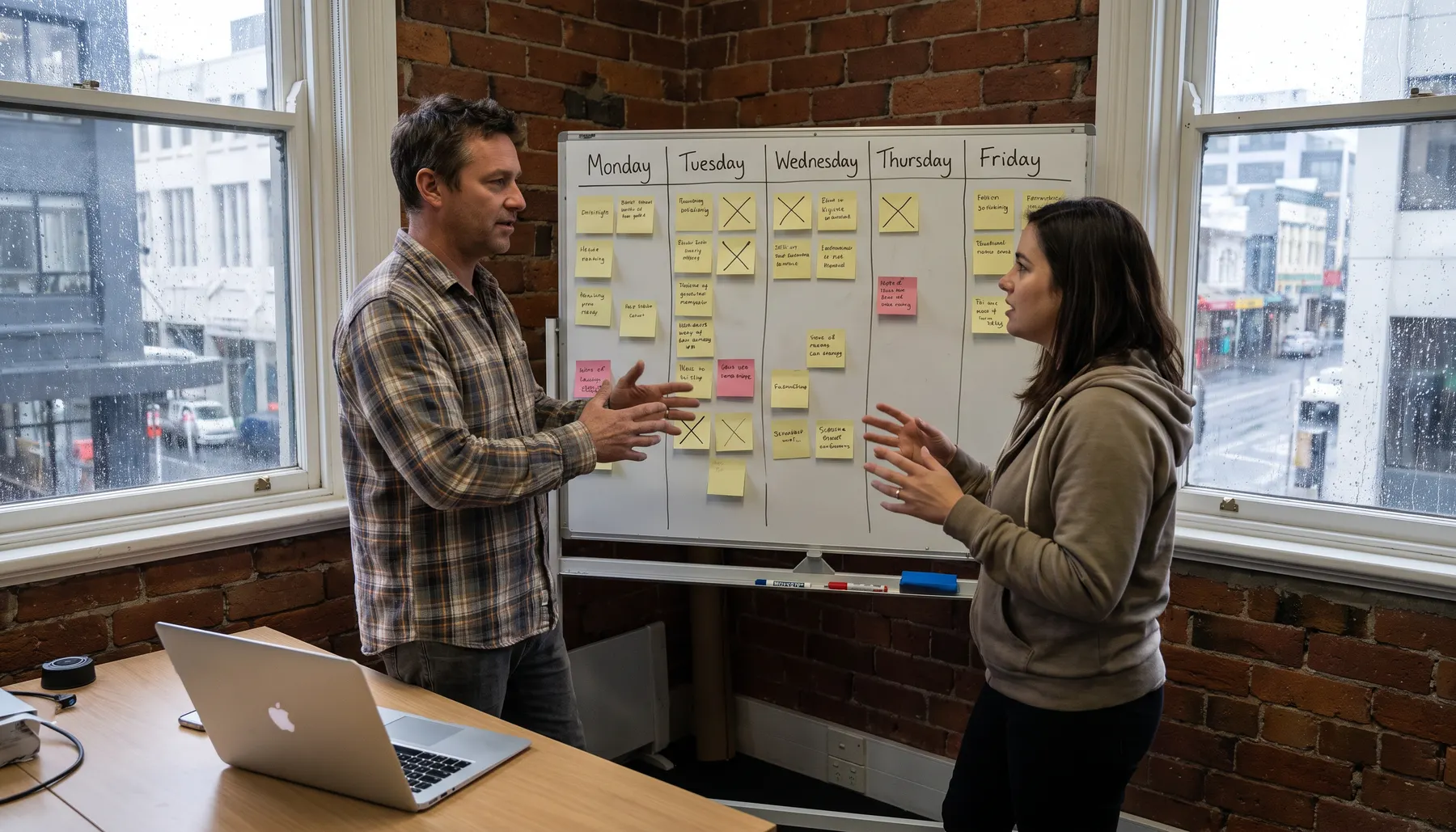 The week map · day one
We sit with the people doing the work for a day and map where the hours go: every email, every re-type, every chase.
The three automations with the most hours back for the least risk, with the approval steps drawn in and a fixed quote.
Live inside a fortnight. For the first week every run asks you before it acts, so you see what it does before it runs alone.
Documentation, training and a monthly tune. Most clients add a new automation every month for the first year.
Most businesses start with three automations and add from there. The scope is written down after the week map, the quote is fixed, and every automation runs beside you before it runs alone.
NZD, ex GST · 2 to 3 weeks
A day of shadowing, then the three automations that give the most hours back, built and running beside you.
NZD, ex GST · 6 to 8 weeks
Eight to twelve automations across sales, money, operations and admin, wired into one run log, with the AI answering from your own documents.
NZD, ex GST · ongoing
A new automation every month, the old ones tuned, and someone to call when a process changes.
Starting prices for our work. AI running costs are shown per run in your dashboard. Most clients spend less in a month than one afternoon of admin.
The chores with the most hours and the least judgement: answering and chasing enquiries, drafting quotes and invoices, sorting the inbox, the weekly report, data entry. We measure the week first, so the first three are chosen on hours back, not on what sounds clever.
Only if you tell it to. Every automation has approval gates. In the first week you approve every run; after that, the rules you set decide what goes out on its own (a payment reminder) and what always waits for a person (a quote over $20,000, anything about a complaint).
The AI drafts, a person decides, and every run is on the record with what it read and what it wrote. Where a mistake would be expensive we add a second model to check the first, and a kill switch sits on every automation.
Usually not. We build on Xero, MYOB, Monday.com, HubSpot, Shopify, Gmail, Outlook, Slack, Tradify and most things with an API. Where there is no API we have built importers and careful browser automations.
Hosted in Sydney or Auckland. Customer data is never used to train anything. We write the data flow down before we build, with the Privacy Act in mind, and you can see and export every run.
The first three automations are usually live inside two to three weeks of the week map. A full operating system across the business is six to eight weeks, rolled out in stages so nothing stops.
Not much. Most clients spend less on AI calls in a month than on one afternoon of admin. The dashboard shows the cost per run, by task and model.
A day with us on the whiteboard, a map of where your hours go, and the three automations that would give the most of them back. Fixed quote, live in a fortnight, a person on every step that matters.
Get a quick quoteTell us what you need. We’ll come back with ideas, a timeframe and a fixed quote.